A letter of recommendation is a formal document written by someone who knows a candidate well and can provide a credible assessment of their skills, character, achievements, and potential. Recommendation letters are commonly requested for college admissions, scholarships, graduate programs, internships, jobs, professional opportunities, and other applications.
A strong recommendation letter goes beyond repeating information from a resume or application. It provides personal insight into how the candidate performs, communicates, solves problems, works with others, and responds to challenges. Specific examples can help the reader understand qualities that may not be obvious from grades, test scores, employment history, or a list of accomplishments.
What Is a Letter of Recommendation?
A letter of recommendation is a written endorsement of a person for a specific opportunity. The person writing the letter is usually someone who has directly observed the candidate’s work, academic performance, leadership, character, or professional abilities.
Depending on the purpose, a recommendation letter may be written by a teacher, professor, employer, manager, supervisor, counselor, mentor, coach, or another qualified professional.
The goal is not simply to say that someone is a good candidate. Instead, an effective letter explains why the recommender believes the candidate is suitable for the opportunity and supports that assessment with relevant details or examples.
When Is a Letter of Recommendation Needed?
Recommendation letters are used in many academic and professional situations. The exact requirements depend on the institution, employer, program, or organization requesting the document.
Common situations include:
- College and university applications.
- Graduate school applications.
- Scholarship applications.
- Internship applications.
- Job applications.
- Professional programs.
- Fellowship applications.
- Leadership programs.
- Volunteer opportunities.
- Academic awards and honors.
- Professional certifications or development programs.
Some applications may specify who should provide the recommendation, how many letters are required, and whether the letter must be submitted directly by the recommender. Applicants should always follow the instructions provided by the organization requesting the recommendation.
Who Should Write a Letter of Recommendation?
The best recommender is generally someone who knows the candidate well enough to provide specific and credible examples. A person’s job title alone does not necessarily make them the right choice.
For an academic application, an appropriate recommender might be a teacher or professor who has observed the student’s academic work. For employment, a manager or supervisor may be able to provide useful information about performance, teamwork, reliability, and professional skills.
Academic Recommendation
An academic recommendation may discuss classroom performance, intellectual curiosity, research ability, participation, writing skills, critical thinking, leadership, or academic growth.
Professional Recommendation
A professional recommendation can focus on work performance, technical skills, communication, leadership, reliability, collaboration, initiative, and accomplishments.
Character Recommendation
A character recommendation generally focuses on personal qualities such as integrity, responsibility, perseverance, maturity, dependability, and community involvement. The recommender should explain these qualities through relevant observations rather than relying only on general praise.
What Should a Letter of Recommendation Include?
A professional recommendation letter should be organized clearly and written for the specific opportunity whenever possible. While formats vary, most effective letters contain several core elements.
1. Recommender Information
The beginning of the letter can include the recommender’s name, title, organization or institution, address, email address, and telephone number. This information helps establish the writer’s relationship to the candidate and provides a way to verify the recommendation if necessary.
2. Date
Include the date when the recommendation letter is written or submitted. This gives the document a clear reference point.
3. Recipient Information
If the recipient’s name and organization are known, include them in the letter. When a specific recipient is not provided, an appropriate general salutation may be used according to the application instructions.
4. Relationship to the Candidate
The recommender should explain how they know the candidate and how long they have known them. This context helps the reader understand the basis for the recommendation.
5. Candidate’s Strengths
The main body should identify several relevant strengths. These might include communication, leadership, analytical thinking, creativity, organization, technical ability, academic performance, teamwork, or perseverance.
6. Specific Examples
Specific examples are often more useful than broad statements. Instead of simply saying that a candidate is a strong leader, the recommender can describe a project, situation, accomplishment, or responsibility that demonstrates leadership.
7. Overall Recommendation
The conclusion should clearly state the recommender’s support for the candidate and connect the candidate’s qualities to the opportunity.
8. Contact Information and Signature
A professional closing can include the recommender’s signature, printed name, title, organization, and contact information.
Letter of Recommendation Template
A letter of recommendation template provides a practical structure for creating a professional recommendation letter. It can help the writer organize the introduction, relationship to the candidate, qualifications, examples, recommendation, and closing without starting from a completely blank page.
The printable template below includes areas for the recommender’s information, recipient details, candidate information, recommendation paragraphs, supporting examples, closing statement, and signature.
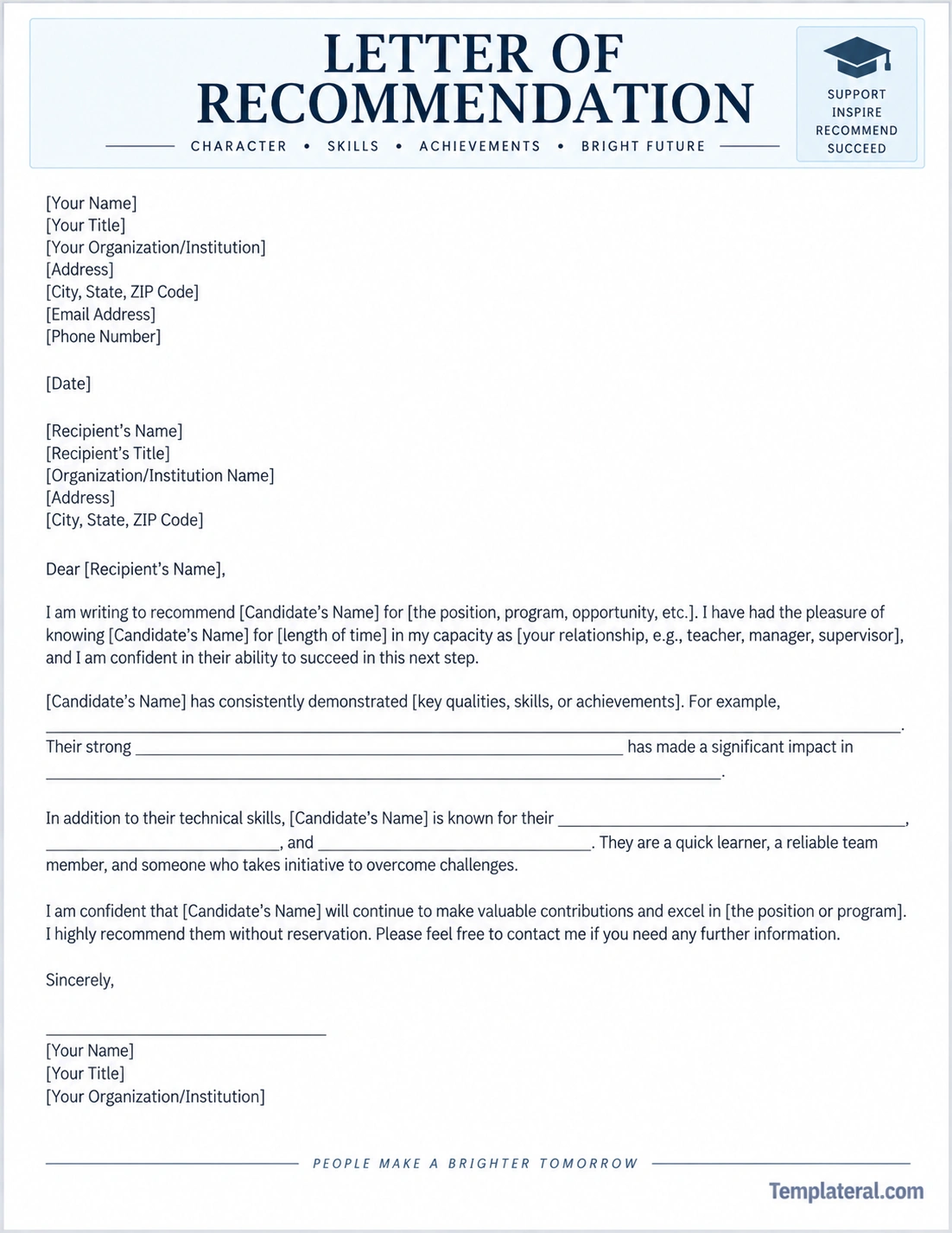
The template can be adapted for academic, professional, scholarship, internship, or other appropriate recommendation purposes. The writer should customize the content rather than submitting a generic letter without considering the candidate and opportunity.
How to Write a Letter of Recommendation
Writing a recommendation letter becomes easier when you first gather the information needed to create a specific and meaningful endorsement.
Step 1: Understand the Purpose
Find out why the candidate needs the letter. A recommendation for graduate school may emphasize academic ability and research potential, while a professional recommendation may focus more heavily on job performance and workplace skills.
Knowing the purpose allows the writer to select examples that are relevant to the opportunity.
Step 2: Review the Candidate’s Information
Ask the candidate for useful background information. This might include a resume, curriculum vitae, personal statement, list of accomplishments, application details, job description, program information, or specific instructions from the requesting organization.
This information can help the recommender avoid factual errors and choose examples that support the candidate’s application.
Step 3: Identify the Candidate’s Strongest Qualities
Choose two or three qualities that are genuinely supported by the recommender’s experience with the candidate. Relevant qualities are usually more valuable than a long list of unrelated strengths.
Step 4: Provide Specific Examples
Support each major claim with an example whenever possible. Explain what the candidate did, what role they played, and what the experience demonstrates.
For example, rather than writing that a student has excellent problem-solving skills, a recommender might describe how the student approached a difficult research assignment, identified a problem, developed a solution, and improved the final result.
Step 5: Connect the Qualities to the Opportunity
Explain why the candidate’s demonstrated qualities are relevant to the position, program, scholarship, or other opportunity. This makes the recommendation more focused and useful to the reader.
Step 6: Write a Clear Conclusion
End the letter with a concise statement of support. The recommender can summarize the candidate’s strongest qualities and provide contact information for additional questions if appropriate.
How Long Should a Recommendation Letter Be?
There is no single length that applies to every recommendation letter. The appropriate length depends on the purpose and the instructions provided by the organization requesting it.
In general, the letter should be long enough to provide meaningful context and specific examples without becoming repetitive. A focused letter with several strong examples is usually more useful than a much longer document filled with general praise.
If the application specifies a word count, character limit, page limit, or submission format, those requirements should take priority.
How to Make a Letter of Recommendation Stronger
The quality of a recommendation letter often depends on how specific and relevant the content is. Consider these practical strategies when preparing the letter.
- Be specific: Use concrete examples instead of vague compliments.
- Be relevant: Focus on qualities that matter for the opportunity.
- Be honest: Only describe qualities and achievements the recommender can genuinely support.
- Show the relationship: Explain how the writer knows the candidate.
- Use evidence: Describe projects, achievements, responsibilities, or situations that demonstrate key qualities.
- Customize the letter: Adapt the content to the particular application whenever possible.
- Maintain a professional tone: Keep the language appropriate for the recipient and purpose.
- Proofread carefully: Check names, titles, dates, organization names, and other important details.
Common Mistakes to Avoid
A recommendation letter can become less effective when it contains generic language, unsupported claims, or information that is not relevant to the application.
Using Generic Praise
Statements such as “excellent student” or “hardworking employee” are more meaningful when they are followed by evidence. A specific example gives the reader a reason to believe the assessment.
Repeating the Resume
A recommendation letter should add perspective rather than simply reproduce the candidate’s resume. The recommender can provide context about how the candidate approached challenges, contributed to a team, or developed over time.
Including Irrelevant Information
Not every achievement needs to be mentioned. Select information that supports the purpose of the recommendation.
Failing to Proofread
Incorrect names, job titles, school names, dates, or pronouns can make an otherwise strong letter appear careless. Review the document carefully before submitting it.
Making Unsupported Claims
A recommender should avoid exaggerating accomplishments or describing qualities they have not personally observed. A credible recommendation is based on genuine experience.
Letter of Recommendation for College
A college recommendation letter can provide admissions readers with additional context about a student’s academic performance, character, classroom participation, intellectual interests, and personal development.
A teacher or counselor may describe how the student contributes to class, handles challenging assignments, works with peers, demonstrates curiosity, or responds to feedback.
The most useful examples are those that provide information beyond grades and basic application data.
Letter of Recommendation for a Job
A professional letter of recommendation can describe an employee’s performance, skills, accomplishments, reliability, communication, leadership, teamwork, and ability to handle responsibilities.
When writing a job recommendation, the writer should consider the position the candidate is pursuing. For example, a recommendation for a management position may emphasize leadership and decision-making, while a technical role may require greater attention to technical skills and problem-solving.
Letter of Recommendation for a Scholarship
A scholarship recommendation letter may focus on academic achievement, leadership, service, perseverance, character, financial or educational goals when appropriate, and the candidate’s potential to contribute to their field or community.
The writer should review the scholarship’s criteria before preparing the letter so that the examples and qualifications discussed are relevant to the selection requirements.
Tips for Requesting a Letter of Recommendation
If you are the person requesting a recommendation, make the process as easy as possible for the writer.
- Ask the recommender well before the deadline.
- Explain what the letter is for.
- Provide the submission deadline.
- Share the application instructions.
- Provide your resume or relevant background information.
- Explain why you selected the recommender.
- Provide useful details about the opportunity.
- Send reminders respectfully when appropriate.
- Thank the recommender after the letter has been submitted.
Giving the recommender enough context can make it easier for them to write a specific letter based on their actual experience with you.
Frequently Asked Questions About Letters of Recommendation
What is the purpose of a letter of recommendation?
The purpose of a recommendation letter is to provide an independent person’s perspective on a candidate’s qualifications, character, skills, achievements, and potential for a particular opportunity.
Who can write a letter of recommendation?
A teacher, professor, employer, supervisor, manager, counselor, mentor, coach, or another appropriate professional may write a recommendation, depending on the requirements of the organization receiving the letter.
What makes a recommendation letter effective?
An effective letter is specific, relevant, credible, and supported by examples. It explains the writer’s relationship with the candidate and connects the candidate’s demonstrated qualities to the opportunity.
Can I use a letter of recommendation template?
Yes. A template can provide a useful structure for organizing the letter. However, the content should be customized to reflect the recommender’s genuine experience with the candidate and the requirements of the specific opportunity.
Should a recommendation letter be formal?
Yes. A recommendation letter should generally use a professional and respectful tone. The exact style can vary depending on the relationship between the recommender, candidate, and recipient.
Should a recommendation letter include examples?
Yes. Specific examples can make a recommendation more credible and informative. They demonstrate how the candidate has actually displayed the qualities described in the letter.
Conclusion
A letter of recommendation gives an admissions committee, employer, scholarship provider, or other decision-maker a personal perspective on a candidate’s qualifications and potential. Unlike a resume or application form, it can explain how the candidate performs in real situations and provide examples of their character, skills, achievements, and growth.
A well-organized letter of recommendation template can simplify the writing process by providing a clear structure for the recommender’s information, candidate relationship, key strengths, supporting examples, recommendation statement, and signature. The template should be treated as a starting point rather than a replacement for thoughtful, personalized writing.
The strongest recommendation letters are specific, honest, relevant, and supported by genuine observations. By focusing on meaningful examples and connecting the candidate’s qualities to the opportunity, a recommender can create a professional document that provides useful context and a clearer picture of the person being recommended.
Download: Letter of Recommendation Template
