A plotting diagram is a visual tool that helps writers and students organize the events of a story from beginning to end. By placing important story events into a clear structure, a plotting diagram makes it easier to understand how characters, conflict, tension, and resolution work together.
Whether you are planning a short story, analyzing a novel, preparing a creative writing assignment, or teaching narrative structure, a plot diagram can turn a complicated story into an easy-to-follow visual map. It helps identify what happens first, how the conflict develops, where the story reaches its highest point, and how the events lead toward a resolution.
What Is a Plotting Diagram?
A plotting diagram is a graphic organizer used to represent the structure of a narrative. It usually places major story events along a visual path that shows how the action develops over time.
One of the most common versions follows five basic stages: exposition, rising action, climax, falling action, and resolution. Together, these stages provide a simple framework for understanding how a traditional story develops.
A plotting diagram can be used for both story planning and story analysis. Writers can use one before drafting a story, while readers and students can complete one after reading a book or short story.
Why Use a Plotting Diagram?
Stories can contain many characters, events, conflicts, and changes. Without a clear structure, it can be difficult to see how all these elements connect. A plotting diagram simplifies the narrative by focusing attention on the most important events.
Using a plot diagram can help you:
- Organize story ideas before writing.
- Identify the main conflict.
- Understand how tension develops.
- Find the turning point of a story.
- Track important events in chronological order.
- Understand how characters respond to conflict.
- Plan a stronger beginning, middle, and ending.
- Analyze the structure of a novel, short story, or other narrative.
For students, a plotting diagram can also make literary analysis more manageable. Instead of trying to remember every event, students can focus on the events that significantly affect the direction of the story.
The Five Main Parts of a Plotting Diagram
A traditional plot diagram often divides a story into five major stages. Each stage has a different purpose and contributes to the overall movement of the narrative.
1. Exposition
The exposition introduces the basic elements of the story. Readers typically learn about the setting, important characters, and the situation at the beginning of the narrative.
The exposition may also introduce the central problem or conflict that will drive the rest of the story. It gives readers enough context to understand what happens next.
When completing this section of a plotting diagram, consider questions such as:
- Who are the main characters?
- Where does the story take place?
- When does the story take place?
- What is the initial situation?
- What problem or conflict is introduced?
2. Rising Action
The rising action includes the events that develop the central conflict. Problems become more complicated, characters face obstacles, and tension gradually increases.
This section may contain several important events rather than just one. Each event should contribute to the development of the story and move the characters closer to the climax.
For writers, the rising action is useful for checking whether the story has enough meaningful development between the introduction and the major turning point.
3. Climax
The climax is the major turning point or highest point of tension in a traditional plot structure. It is often the moment when the central conflict reaches its most significant stage.
The climax does not necessarily mean the biggest action scene. Its importance comes from the way it changes the direction of the story or forces a character to make an important decision.
When identifying the climax, ask: What event changes the course of the story?
4. Falling Action
The falling action consists of events that follow the climax. The central conflict begins to move toward an outcome, and some of the questions created earlier in the story start to receive answers.
This part of the plotting diagram helps connect the major turning point to the ending. Depending on the story, falling action may be brief or may include several important events.
5. Resolution
The resolution is the stage where the main conflict reaches an outcome and the story comes to an end. It shows what happens after the major conflict has been addressed.
The resolution does not always mean that everything ends happily. A story can have a positive, negative, uncertain, surprising, or bittersweet ending. The important point is that the main narrative moves toward a conclusion.
Plotting Diagram Template
A printable plotting diagram template provides a structured space for organizing the major parts of a story. Instead of writing a long summary, users can record important events in the appropriate section of the plot structure.
The following template uses a visual story arc with five stages: exposition, rising action, climax, falling action, and resolution. It also includes areas for the main characters, setting, and additional notes.
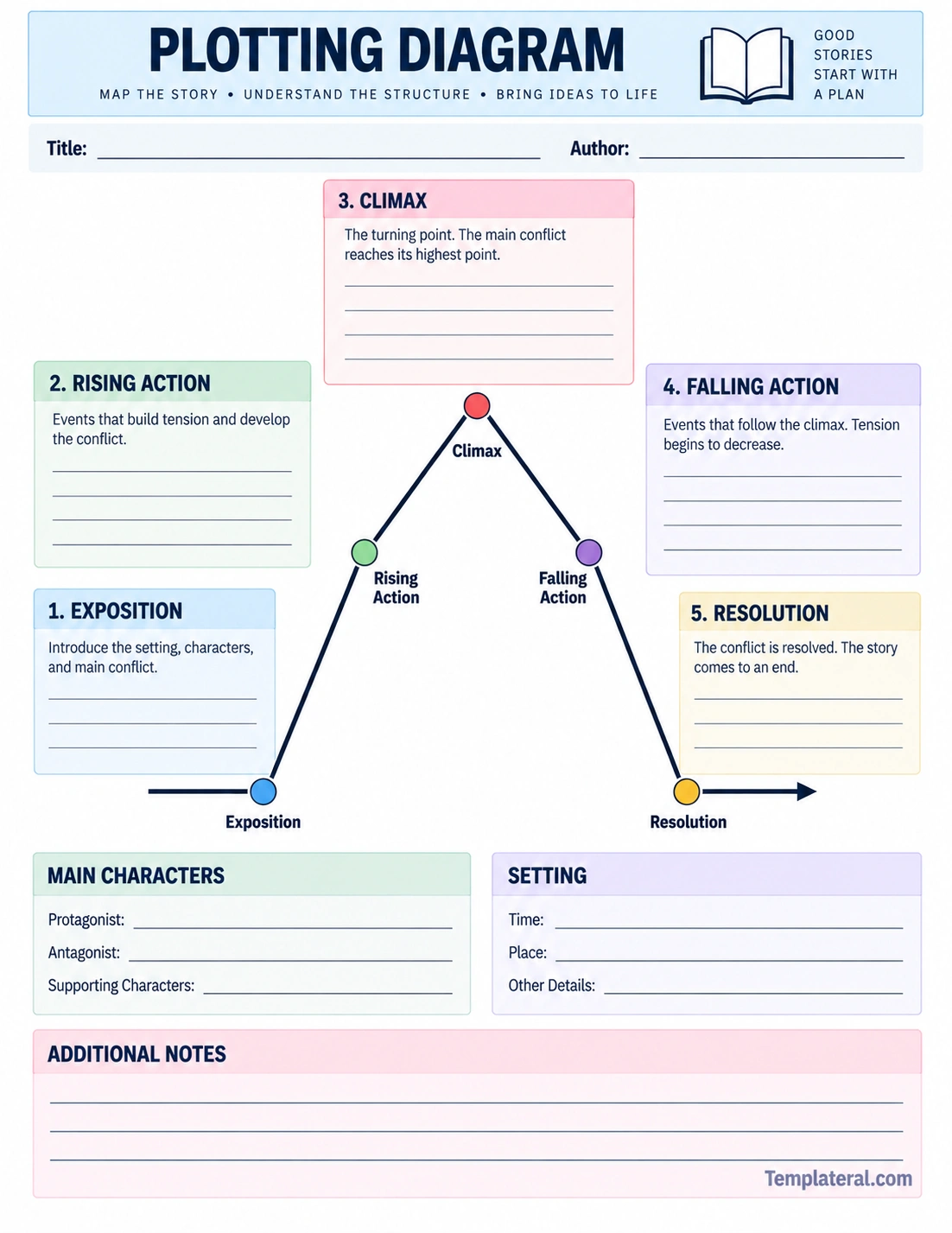
The template can be used as a printable story map for creative writing, reading comprehension, literary analysis, and classroom activities. Students can write directly into each section and use the visual story arc to see how the events connect.
How to Fill Out a Plotting Diagram
Completing a plotting diagram is easier when you work through the story in sequence. Start with the basic information and then identify the events that have the greatest impact on the narrative.
Step 1: Identify the Main Characters
Begin by listing the protagonist, antagonist, and important supporting characters. You do not need to include every character in the story. Focus on the characters who influence the main conflict or major events.
Understanding the characters makes it easier to explain why important events happen later in the plot.
Step 2: Record the Setting
Write down the primary time and place of the story. If the setting changes significantly during the narrative, include the locations or time periods that directly affect the plot.
The setting can influence the characters, create obstacles, establish mood, or affect how the conflict develops.
Step 3: Describe the Exposition
Summarize the beginning of the story in a few concise points. Identify the initial situation, introduce the important characters, and note the main conflict if it has already been established.
Step 4: List the Rising Action
Identify the major events that make the conflict more complicated. Look for obstacles, discoveries, decisions, confrontations, and other events that increase tension.
Try not to list every minor event. A useful plotting diagram focuses on events that change the direction of the story.
Step 5: Find the Climax
Determine the most important turning point. Ask yourself which event creates the biggest change in the conflict or forces the protagonist to make a significant choice.
Step 6: Explain the Falling Action
Record the important events that occur after the climax. Consider how the characters respond to the consequences of the turning point and how the main conflict moves toward an outcome.
Step 7: Summarize the Resolution
Finish the diagram by explaining how the story ends. Describe what happens to the main characters and how the central conflict is resolved or left open.
Plotting Diagram for Story Writing
Writers can use a plotting diagram before writing a first draft. This approach can help prevent a story from becoming a collection of unrelated events.
Start by deciding what the protagonist wants and what prevents them from achieving that goal. Then build a sequence of events that gradually increases the difficulty of the conflict.
A simple planning process might look like this:
- Exposition: Introduce the character, setting, and initial problem.
- Rising action: Create obstacles that make the problem more difficult.
- Climax: Bring the central conflict to its major turning point.
- Falling action: Show the consequences of the turning point.
- Resolution: Establish the outcome of the story.
This structure does not need to limit creativity. Writers can modify the pacing, use flashbacks, introduce multiple conflicts, or experiment with nonlinear storytelling. The diagram is simply a planning tool.
Plotting Diagram for Students
A plotting diagram can be particularly useful for students learning about story structure and narrative elements. It gives students a visual framework for breaking down a complex reading assignment.
Teachers can use a plot diagram worksheet for individual assignments, small-group activities, reading responses, or classroom discussions.
For younger students, each section can be completed with one or two sentences. Older students can provide more detailed explanations about character motivation, conflict, themes, and the significance of individual events.
Questions Students Can Ask
- What is the main conflict?
- Who is the protagonist?
- What events make the conflict more difficult?
- Which event creates the biggest turning point?
- What happens after the climax?
- How is the main conflict resolved?
- How does the ending affect the main character?
Plotting Diagram vs. Story Map
A plotting diagram and a story map are closely related, but they can serve slightly different purposes.
A plot diagram usually focuses on the sequence and development of the narrative, especially the movement from exposition through resolution. A story map can be broader and may include additional elements such as characters, setting, theme, problem, solution, and important details.
Both tools can be useful. The right choice depends on what you want to analyze or plan.
Tips for Making a Useful Plot Diagram
A good plotting diagram should be concise enough to understand at a glance. Avoid filling every section with long paragraphs.
- Focus on major events: Include events that significantly affect the plot.
- Use concise descriptions: Summarize each event in a sentence or short phrase.
- Follow the sequence: Place events in the order needed to understand the story structure.
- Identify cause and effect: Consider how one event creates or influences another.
- Pay attention to conflict: Track how the central problem develops throughout the story.
- Highlight the turning point: Make sure the climax is clearly identified.
- Review the complete diagram: Check whether the beginning, middle, and ending form a logical progression.
Common Mistakes When Using a Plotting Diagram
One common mistake is trying to include every event from a story. A plot diagram is more useful when it focuses on the events that drive the narrative forward.
Another mistake is confusing the climax with the ending. The climax is the major turning point, while the resolution explains what happens as the story reaches its conclusion.
It is also possible to mistake a simple exciting event for the climax. Instead, consider whether the event significantly changes the central conflict or the direction of the narrative.
Finally, avoid treating every story as if it must follow exactly the same structure. Some modern stories use multiple plotlines, circular structures, open endings, or nonlinear timelines. A traditional plotting diagram is a framework, not a rule that every story must follow.
Frequently Asked Questions About Plotting Diagrams
What is the purpose of a plotting diagram?
The purpose of a plotting diagram is to visually organize the major events and structure of a story. It can help writers plan narratives and help readers understand how a story develops.
What are the five parts of a plot diagram?
The five commonly taught parts are exposition, rising action, climax, falling action, and resolution. Together, they represent a traditional narrative structure.
What should I put in the climax section?
Put the major turning point of the story in the climax section. This is usually the event where the central conflict reaches its highest level or where an important decision changes the direction of the narrative.
Can a plotting diagram be used for a novel?
Yes. A plotting diagram can be used for a novel, short story, screenplay, children’s book, or other narrative. For longer works, you may create one diagram for the overall story and additional diagrams for individual chapters or subplots.
Can writers use a plot diagram before writing?
Yes. Writers can use a plotting diagram as a planning worksheet before drafting. It can help organize characters, conflict, major events, and the ending before the full story is written.
Conclusion
A plotting diagram is a simple but useful way to visualize how a story develops from its introduction to its conclusion. By organizing the exposition, rising action, climax, falling action, and resolution, readers can better understand the relationship between major events and the central conflict.
For writers, a plotting diagram can serve as a practical story-planning tool. For students and teachers, it can turn narrative analysis into a clear visual exercise. Whether you are outlining a new story or studying an existing one, a printable plotting diagram template provides an easy place to organize ideas, identify key events, and understand the overall shape of a narrative.
Download: Plotting Diagram
